
In a string of seaside postcodes, asking prices have been chopped by up to 30% as lenders, insurers and buyers digest the new lines drawn on the sand. If your front door faces a cliff, dune or soft estuary bank, the question is suddenly sharp: is your house safe, and for how long?
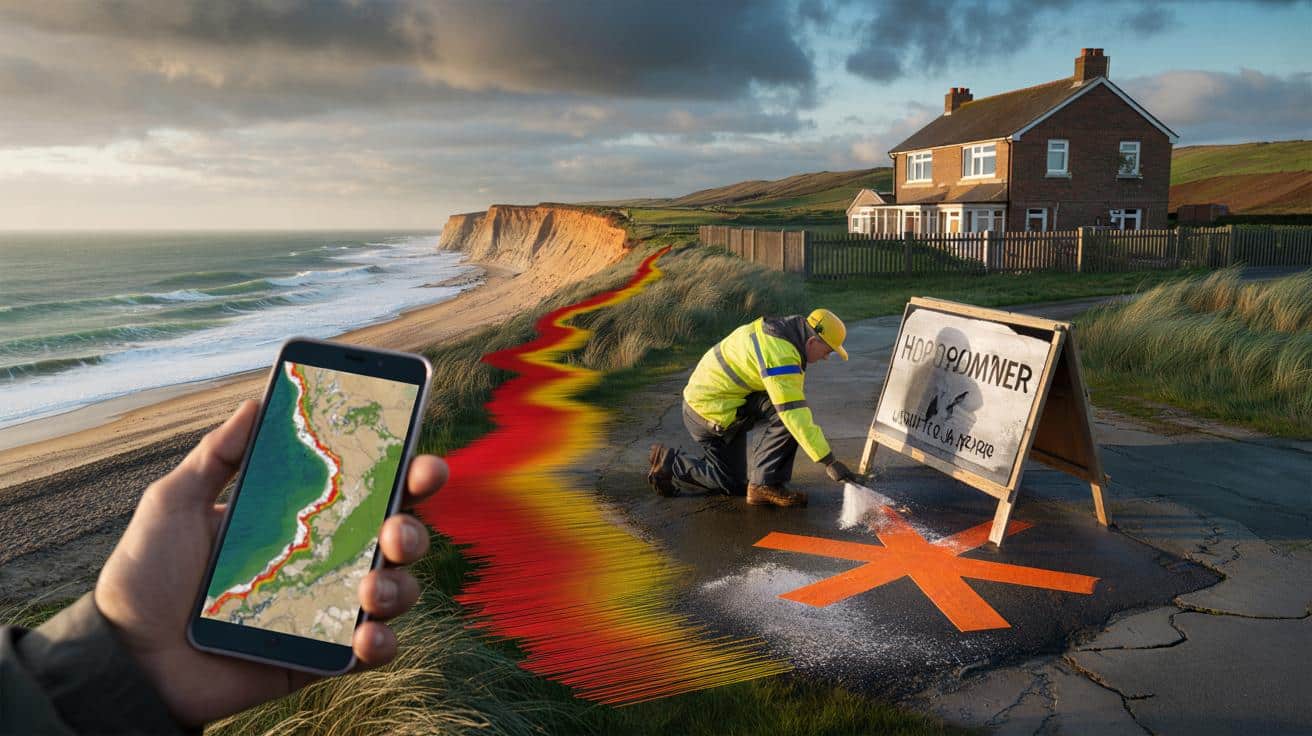
The morning the maps went live, I stood on a windy crescent above the beach at Hemsby, Norfolk. A surveyor marked an orange X on the tarmac, while a seller wiped salt spray from a “For Sale” board no one wanted to photograph. On phones, the new overlays glowed like a weather warning: red for rapid retreat, amber for watch and wait. A couple in cycling helmets paused, stared, and quietly walked back to their car. The shoreline wasn’t the only thing moving. Then the map flashed red.
The maps that changed the conversation
You can feel the tone shift in coastal living rooms. The **2026 erosion maps** don’t speak in riddles; they draw a set of retreat bands for 20, 50 and 100 years and colour them with unapologetic clarity. They fuse LiDAR, storm-track data and updated shoreline management policies into one picture, the kind of picture a bank manager can’t ignore. For years, erosion was a story told by neighbours and winter storms. Now it sits in a neat legend, ready to be indexed by portals and pricing models.
The shock is local and personal. In HU19 (Withernsea) and YO15 (around Bridlington), valuations on clifftop semis have been marked down as deals wobble, with agents whispering of a **30% hit** where maps turn from amber to red. In NR29 and NR12 on the Norfolk coast, a tidy bungalow that was £265,000 last spring is now circling offers near £190,000, while cash buyers try their luck with cheeky bids. One retired couple told me they’d planned to downsize in three years. The new lines nudged that plan into next month.
This isn’t only fear. It’s mechanics. Lenders model a 25-year mortgage against a map that hints at a shorter runway. Insurers price in more frequent claims and tighter conditions, and suddenly the monthly cost of living there nudges higher. When risk hardens into numbers, buyers don’t vanish—they just reprioritise. Cash steps forward, mortgages hang back, and time-in-home shifts from open-ended to explicit. A seaside house becomes less like a forever home and more like a timed asset with a view.
What homeowners can do this week
Start with precision, not panic. Pull up the 2026 layers for your stretch and note where your plot sits relative to the 20- and 50-year bands. Cross‑check it with your local Shoreline Management Plan policy—“Hold the line” is different from “Managed realignment” or “No active intervention”. Keep screenshots with dates. Speak to your broker and insurer in writing so you have a clean record of terms and timelines. Small, methodical steps beat noisy denial. And yes, **check your postcode**.
Don’t play the hero alone. Common mistakes: dismissing red bands as “overcautious”, assuming insurance will renew on identical terms, or spending £20,000 on a kitchen and nothing on exit strategy. Talk to the council’s coastal team about what’s being monitored on your frontage. Gather your last survey, drainage reports and any old planning notes. We’ve all had that moment when a nagging doubt turns into a spreadsheet at 2am. Give it daylight. Let a coastal engineer look, even if it’s a desktop review. Let’s be honest: nobody really does that every day.
Price and language matter if you’re selling. Buyers don’t mind risk as much as they mind surprises, which is why clear disclosures and a pragmatic price can save you months of limbo.
“People will buy the coast,” a coastal valuer in East Anglia told me, “but they want to know the horizon, the policy, and the plan. A fair price makes the rest feel honest.”
- Get a short, independent erosion note and share it up front.
- Ask your lender and insurer for written terms 6–12 months ahead.
- Use map overlays in your listing, not just sunsets and sea spray.
- Frame it as a time‑limited coastal home, not a mythic forever.
- Explore council adaptation grants or relocation schemes where available.
- If you’re staying, move key electrics up, rethink outbuildings, and log every maintenance task.
The bigger shift: from seaside dream to timed asset
The coast isn’t closing; it’s changing its contract. The maps make explicit what locals have long known—that some stretches will be held, some will be reshaped, and some will be let go. There’s a strange clarity in that. A house with a horizon can still be a good buy if price and plan line up. A community with a plan can still thrive when the camera moves down the road. *Time, tide, and maps wait for no one.* What’s emerging is a new grammar for value: not just “where is it?”, but “how long is it?” That shift can sting, and it can also focus the mind. The coast calls. The numbers answer.
| Key point | Detail | Interest for the reader |
|---|---|---|
| New maps reset risk | 2026 layers show 20/50/100-year retreat bands and policy stances | Understand why lenders, insurers and buyers reprice coastal homes |
| Price moves cluster by postcode | NR29, NR12, HU19, YO15, BN16, PO20, TR7 show sharper discounts | Spot where the market is moving fastest—and how your area compares |
| Action beats anxiety | Map check, SMP policy, early insurer/broker talks, realistic listing strategy | Concrete steps to protect value, speed decisions, and avoid costly surprises |
FAQ :
- Will my mortgage be pulled if my postcode turns red?Banks rarely pull existing loans solely on a map update. The bigger impact is on remortgaging and new lending, where tighter criteria and lower loan‑to‑value ratios kick in. Expect more questions and potentially higher rates or lower offers.
- Can I challenge the map for my individual plot?You can submit site‑specific evidence via your council or commissioning body and commission a coastal engineer’s letter. Maps are strategic and won’t flip overnight, yet credible local data can inform future updates and help with lender or insurer conversations.
- Does erosion risk affect insurance the same way flood risk does?Insurers treat them differently. Flood is often priced with excesses and conditions; active cliff or dune erosion can lead to exclusions, short‑term cover, or outright refusal. Document stability work and policies on your frontage to keep options open.
- Is it still possible to sell a home in a red zone?Yes, at the right price with full disclosure. Cash buyers, local downsizers and lifestyle purchasers still transact where the horizon is known. Framing, timing, and transparent reports help keep chains intact.
- Can I build private defences to protect my property?It depends on the Shoreline Management Plan. “Hold the line” areas may support works with consents; “Managed realignment” or “No active intervention” areas are much harder. Speak to the council’s coastal team before spending on designs.








Can lenders really adjust LTVs just because a postcode flips from amber to red, or do they look at plot‑specific evidence? If I commission a coastal engineer’s desktop review, will banks weigh that over the generic 2026 layer? Practical experiences welcome.