
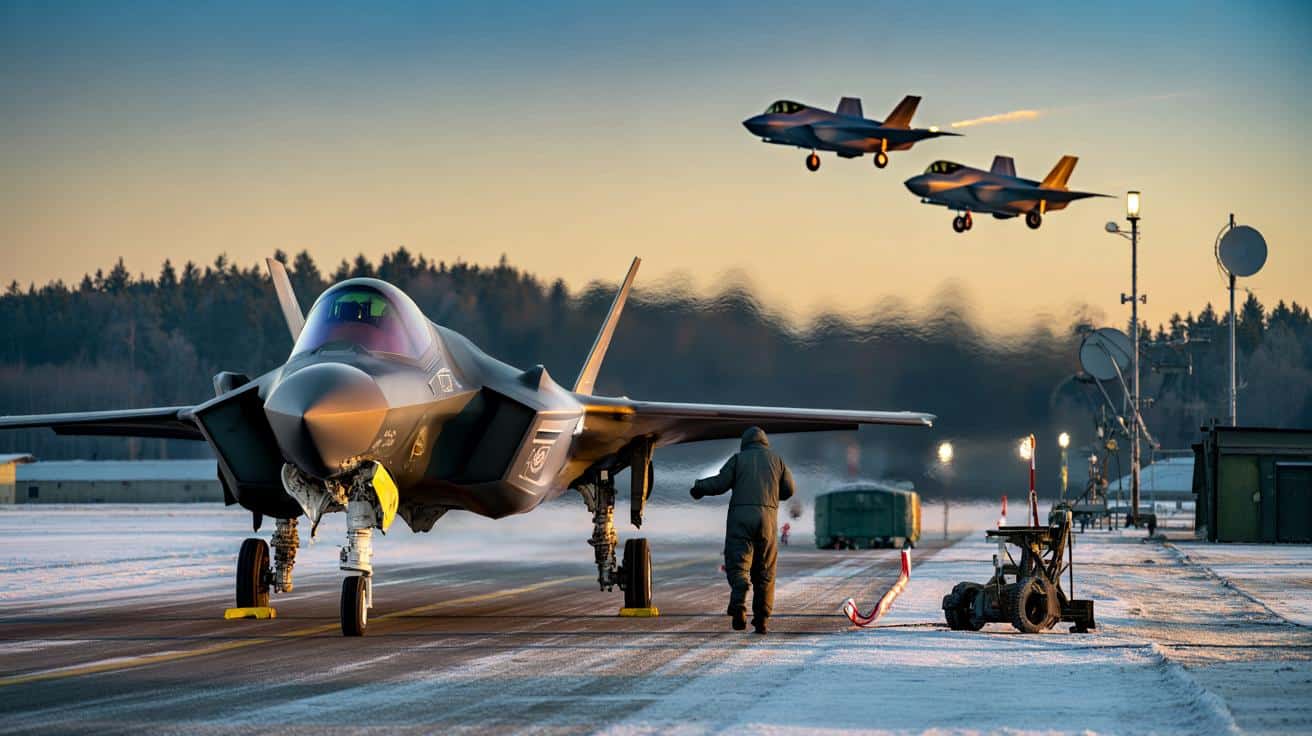
F-35s now sit on hardened aprons from the North Sea to the Black Sea, their presence visible only when you know what to look for: matted grey tails, new shelters, quiet runway works at dawn. Allies who once flew legacy jets are signing for stealth, and the rhythm of air policing patrols has shifted. The question isn’t whether the F-35 is here. It’s why its footprint grew so fast, and what that pace really means.
The winter sun was low over a cold Polish runway when I watched two F-35s taxi, canopies glinting like shards in the frost. The crews moved with that unhurried urgency you only see when the stakes are real. A ground chief flicked a gloved hand and the jets rolled, almost whispering, almost not there at all. Onlookers barely spoke, as if words might bounce off the stealthy edges. *It felt oddly quiet.* Then the roar hit a second later. A beat out of time. It stays with you.
The quiet arrival of a noisy shift
What looked sudden is the product of long choices. Denmark and Norway already field F-35 squadrons; the Netherlands flies them for NATO air policing; Italy deploys them beyond home. Poland has inked for dozens, Finland is joining the club, the Czech Republic signed on, and Germany chose the jet to keep nuclear-sharing credible. That’s not a fad. It’s a regional vote that the next ten years of airpower will be about sensing first, connecting first, and only then shooting. The F-35 is built for that order.
Walk a ramp in Romania or Estonia and the clues pile up. New fibre spools snake toward hardened shelters. SATCOM dishes bloom like winter mushrooms. Even the fuel bowsers look different, paired with compact power carts feeding software updates and thermal conditioning. None of this makes headlines, yet it’s the infrastructure that turns a stealth jet into a network node. We’ve all had that moment when you realise the big story was the little detail you kept stepping over.
Here’s the logic. Air defence in Eastern Europe is dense and twitchy, couched in contested electronic spectrum and fast-moving ground threats. Legacy jets can still fight, but they tax the pilot with raw data and radio calls. The F-35 fuses radar, infrared, and electronic support into a single picture, then shares it discreetly. That turns a two-ship into a floating reconnaissance and strike package, with eyes beyond the horizon and a memory for patterns. **Sensor fusion** isn’t a slogan; it’s the difference between hunting and being hunted.
How to read the F-35’s rise without the hype
Start with basing, munitions, and data. Follow where permanent shelters appear and where temporary ramps get winterised. Track deliveries of stand-off weapons suited to the jet’s bays. Watch the links: Link 16 capacity, new gateways, and cryptographic upgrades. This is a method, not a mystery. If those three lines thicken in the same country, the F-35 is moving from cameo to lead role. If they stall, the jet is visiting, not anchoring.
A common mistake is judging the F-35 like a Top Trumps card. Top speed, turn rate, missile count. That mindset misses where air wars are going. You win by being the first to see a target and the last to be seen yourself, while keeping the team stitched together. Don’t forget people, either. Air forces can buy jets faster than they grow instructors. Let’s be honest: nobody actually does that every day. Training pipelines and maintenance depth still make or break capability.
There’s another trap: thinking stealth means invincible. **Stealth isn’t invisibility**. It’s a delay, a blur at the edge of the radar picture that buys you time to act smarter.
“The jet is a sensor with wings,” one veteran instructor told me. “If I shoot, great. If I don’t, but my data lets someone else nail the target from safety, that’s victory too.”
And here’s a simple watcher’s checklist to keep handy:
- Count the nights: are crews flying and maintaining through darkness and cold snaps?
- Look for runway works: arrestor gear, lighting, and fresh taxiway shoulders mean ops tempo is rising.
- Note bandwidth: new dishes and vans signal data is the main currency.
- Listen for electronic warfare drills: jamming practice tells you the airspace is contested by design.
What this means for Eastern Europe, right now
Eastern Europe’s air picture is becoming less about bravado flypasts and more about quiet deterrence. The F-35 changes the daily calculus along the Suwałki Gap, across the Baltic corridor, and over the Black Sea approaches. It lets allies patrol with fewer aircraft while seeing more, and it complicates any opponent’s plan to surge missiles or probes. The bigger story is that this isn’t just a new jet. It’s a doctrine shift: dispersed operations, rapid software drops, and a habit of sharing. **It’s a game of logistics** as much as aerodynamics, and the side that sustains the network wins.
Eastern Europe didn’t wake up one morning and find a stealth fleet on the doorstep. It built the ramps, trained the crews, and tuned the radios until the F-35 could plug in and stay. That’s the milestone. And it’s only just begun.
| Key point | Detail | Interest for the reader |
|---|---|---|
| F-35 growth looks sudden | Multiple nations moved from orders to operations, with infrastructure catching up | Explains why headlines spiked and bases look different |
| Capability is a network | Sensor fusion, data links, and munitions integration drive outcomes | Shows what actually makes the jet decisive |
| Watch three signals | Basing upgrades, weapons deliveries, and bandwidth | Gives a simple method to decode future news |
FAQ :
- Is the F-35 really “dominating” Eastern European skies?Dominating here means shaping patrol patterns, deterrence posture, and decision speed. You won’t always see it, but commanders do.
- Can older fighters compete with the F-35?They can contribute, especially with modern missiles and pods, yet the F-35’s edge is sensing and sharing before anyone else.
- What about advanced air defences in the region?Stealth reduces detection range and complicates tracking. Paired with stand-off weapons and jamming, it tilts the risk back toward the defender.
- Isn’t the jet too complex to sustain forward?It’s demanding, yes. Eastern allies are investing in shelters, spares, and IT to keep tempo steady through winter and surge periods.
- Will software updates change the game again?Yes. Spiral upgrades add new weapons, smarter tracking, and better interoperability. The jet you see today won’t be the same next year.






Is “dominating” just PR when stealth is a delay, not invisibility? How much of this footprint is sustained ops vs cameo rotations—basing, bandwidth, munitions deliveries? Also, who’s training enough maintainers? Pipelines don’t scale overnite.