
The play isn’t just about barrels. It’s about borders, law, and who gets to turn the taps when the world is thirsty.
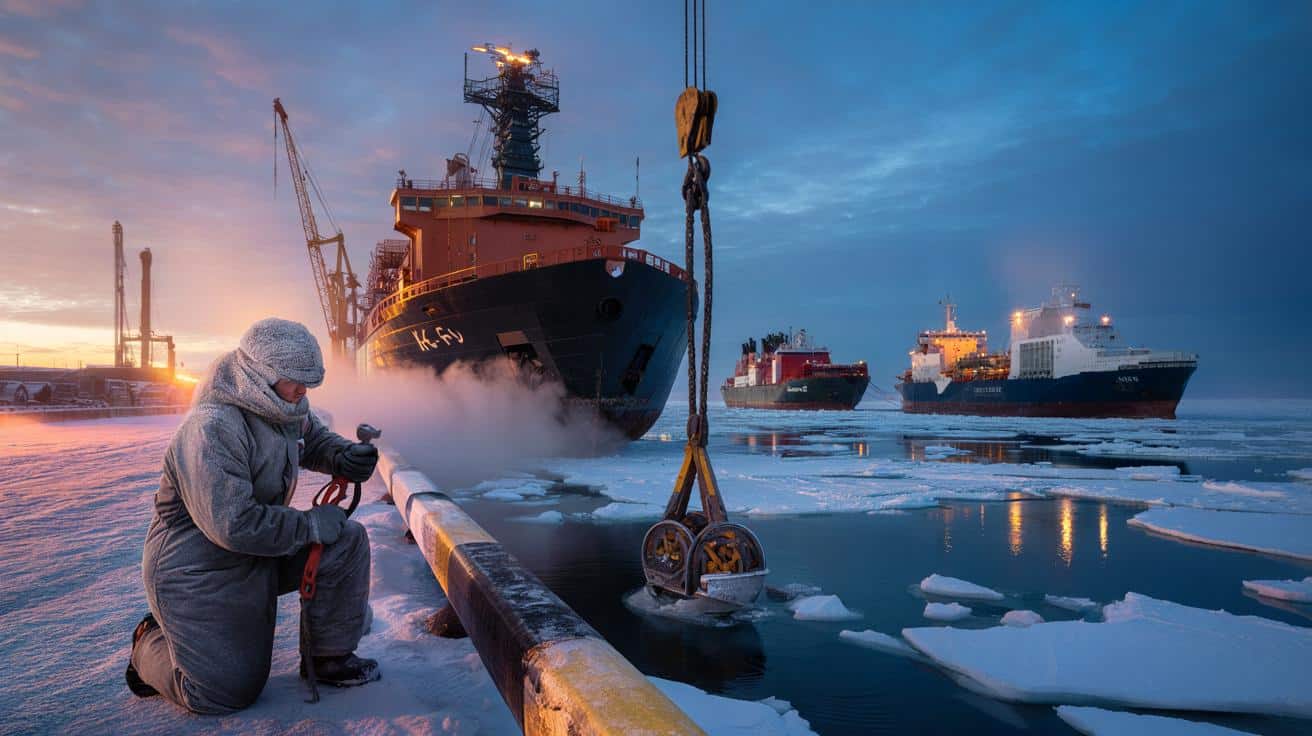
Murmansk at dawn feels like a loading bay for the planet. Ice fog chews at the quays, gulls stitch sharp lines over a deck where men in padded suits test a winch that looks strong enough to lift a town. An LK-60 icebreaker hums at berth, all muscle and patience, waiting for a convoy that’s late again. A young engineer points north with a wrench and says, almost to himself, that the seabed doesn’t wait for politics. Then the harbour horn bleats and everyone moves at once. A cold scramble becomes a routine. And what’s routine becomes policy. A quiet race, brewing in the frost.
The colder scramble: timing, leverage, and the new line on the map
The idea taking shape in Moscow is disarmingly simple: turn the Arctic’s extended continental shelf into a strategic pantry. Officials frame it as continuity, a natural step after years of surveys on the Lomonosov and Mendeleev ridges and filings at the UN Commission on the Limits of the Continental Shelf. The twist is the timing. With tight markets and spare capacity fragile, the Kremlin senses leverage. Sanctions have hardened workarounds, and domestic yards learned to improvise. Ownership claims meet scarcity, and scarcity amplifies claims. That’s how a map turns into a negotiation tool.
You can see it in small scenes that stack up. Rosatom’s icebreakers escort tankers along the Northern Sea Route longer into shoulder seasons, pushing windows that used to be called impossible. Cargo tonnage on that route has set fresh records across recent years, crossing well beyond 30 million tonnes as new convoys test endurance. It felt less like exploration than a deadline. Meanwhile, upstream, licences on the Russian shelf have been stitched to big names—Rosneft, Gazprom, Novatek—while Western kit is swapped for Chinese pipes and domestic sensors. Each bolt tightened is a wedge pushed into the seabed argument: it is ours, it is working, it is needed.
The legal theatre is slow, but it hums. Under UNCLOS, a state can claim an extended continental shelf if geology proves the seabed is a natural prolongation of its land. Russia’s submissions have grown more confident as seismic data piled up, and parts of those claims have drawn encouraging signals from UN experts, even while overlaps with Denmark and Canada remain unresolved. That grey zone is not a pause; it’s a platform. Moscow is using domestic law, leasing, and state-backed insurance to behave as if ownership is already granted, daring others to stop operations on a frozen frontier. Energy scarcity elsewhere makes that dare harder to answer.
How to read the Arctic move like an energy insider
Start with a clean three-step check: law, logistics, liquidity. Law tells you how far a state thinks it can extend control—scan the filings, the maps, the footnotes. Logistics shows what can actually move—icebreakers, storage, terminals, escort fees. Liquidity reveals who pays and how—domestic banks, shadow fleets, long-term offtake in roubles or yuan. Put the three together and you can gauge whether a headline claim is theatre or the opening act of a real build-out. This is less about words than cranes, hulls and balance sheets.
When you scan for risk, resist the trap of treating the Arctic as pure geopolitics. Look for ice-class tonnage additions, seasonal insurance clauses, and the cadence of pilotage bookings at Murmansk and Arkhangelsk. We’ve all had that moment when a story sounds huge until the vessel count tells you it’s a press release in a parka. Let’s be honest: nobody really reads UN annexes on a Friday night. Track the ships, then the money, then the laws that follow both. You’ll miss less. You’ll worry smarter.
There’s a quiet phrase that keeps coming up in Arctic boardrooms:
“Scarcity is writing the policy we were too slow to write.”
- Global shortages: watch diesel spreads, LNG day rates, and refinery outages; tightness magnifies Arctic bargaining power.
- Arctic hardware: count LK-60 icebreakers in service and newbuild timelines; capability equals credibility.
- Lawfare signals: new domestic decrees on shelf leasing, tax holidays, or sovereign insurance hint at the next push.
- Route resilience: note detours from the Suez and Panama bottlenecks; the Northern Sea Route becomes a pressure valve when others clog.
What this means for the rest of us
Energy insecurity doesn’t arrive with a drumroll. It creeps into bills, flight prices, fertiliser costs, and a hundred tiny choices in a supermarket aisle. The Arctic play slots neatly into that feeling. If Russia normalises the idea that deep-sea infrastructure equals sovereign territory, others will test the same logic—from the Barents to the South China Sea. Consumers won’t see court papers; they’ll feel price spikes when a convoy pauses for an ice window or a legal note spooks insurers. Traders will cheer volatility while mayors wonder why buses are late. The seabed is far away until it isn’t.
| Key point | Detail | Interest for the reader |
|---|---|---|
| Arctic claims as leverage | Russia links shelf ownership to real-world logistics and financing | Explains why headlines move prices and policies |
| Shortages change the rules | Scarcity shifts the burden of proof from law to delivery | Helps anticipate sudden market swings at home |
| Follow ships, not slogans | Icebreakers, tonnage, and insurance reveal the truth | Gives a simple method to decode noisy news |
FAQ :
- Is Russia legally “owning” new Arctic seabed right now?Ownership is contested. Russia is advancing extended shelf claims under international law while acting domestically as if control is settled. Final boundaries need agreements with other Arctic states.
- Why link this push to 2026 shortages?Tight markets increase the value of marginal barrels. In a scarcity cycle, claims backed by ships and finance gain traction faster than in periods of surplus.
- What should I watch to see if this is real, not rhetoric?Icebreaker availability, LNG cargo counts, new shelf licences, and any fresh tax holidays or insurance guarantees for Arctic routes.
- Could this spark conflict at sea?Open conflict is unlikely. Expect legal challenges, insurance skirmishes, and diplomatic bargaining, not naval standoffs in the pack ice.
- Does this lower or raise my energy bills?Near term, it tends to raise volatility. If sustained, added Arctic supply can ease pressure, but weather windows, sanctions, and financing can flip the effect quickly.







Sharp piece on timing and leverage. The law–logistics–liquidity lens is useful, but ice-class capacity still looks tight to me—any data beyond Rosatom PR for those shoulder-season convoys and 30m+ tonnes? And how resiliant is that sovereign insurance if secondary sanctions spread?