
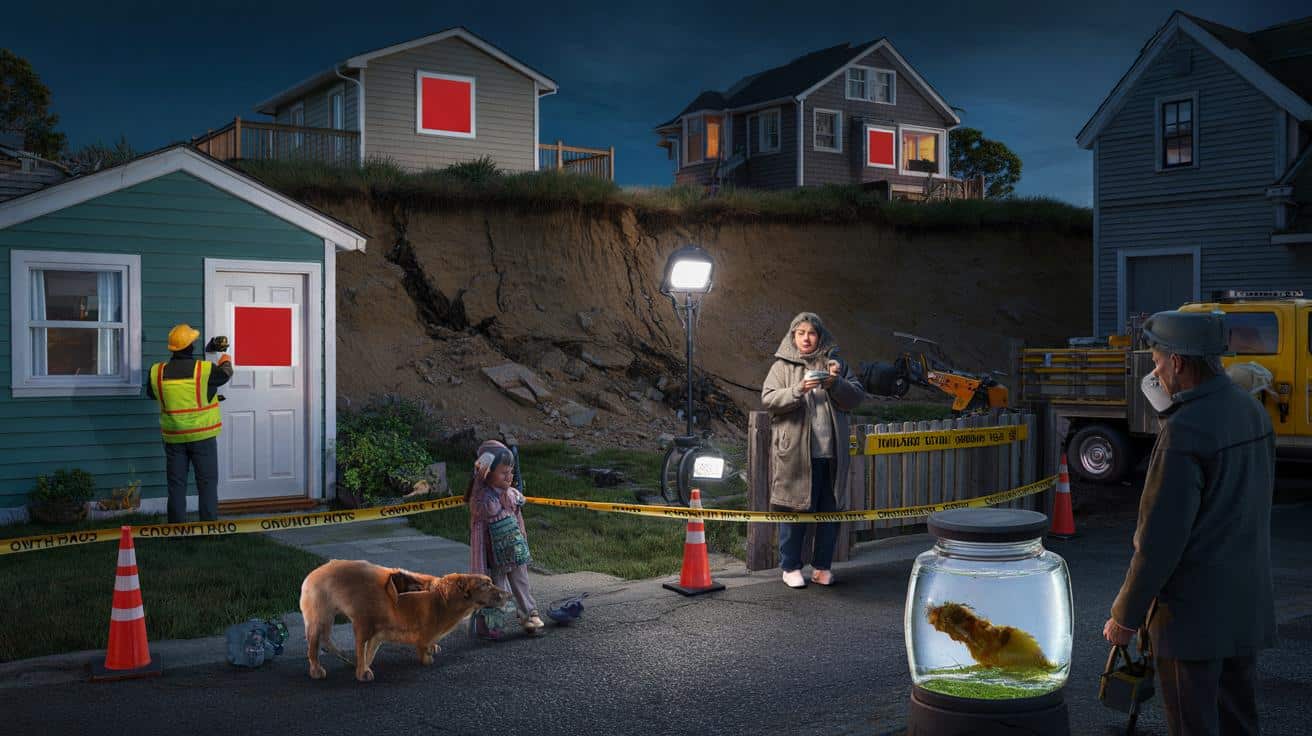
The floodlights came on first, washing the cliff in that strange stadium glow. Neighbours gathered with mugs and torches, watching crews spray a red square on another front door and tape off a garden that had been there at breakfast. A child hugged a goldfish in a jam jar. A builder, shoulders powdery with chalk, shook his head and said nothing. I stood by the police tape and felt the wind push a cold line across my face. Somewhere down below, the sea hit rock with a hollow thump, the kind you feel in your ribs before your ears. *I watched the ground shiver like a living thing.* In the van behind me, a man packed three photo frames and left the fourth, as if the shelf might still be there tomorrow. The ground is moving.
The night the cliff gives notice
Tonight’s red tags landed like verdicts. Three families, rushed out in coats and slippers, were told their homes will be knocked down before dawn if the bluff slumps again. The inspectors didn’t linger. A quick look at the split path, a glance at the fresh crack that ran under the kitchen window, then the sticker: UNSAFE. The sea made its own arguments below, rolling in heavy and quick, a spring tide lit by a fingernail moon. People spoke softly, as if volume could jolt the hillside awake. **A cliff that moved once will move again.** That is the sentence nobody wants to hear, yet you can read it in the faces on the pavement.
One woman showed me a pencil mark in a hallway, the old family trick for measuring children and, lately, the wall itself. Since New Year, the pencil line to the cliff’s edge is two paving stones shorter, by her count, and the council engineers’ notes mention at least a metre of retreat along this run since the last big storm cycle. Her father built the deck; last week, the deck slid, just a few inches, like a sigh. We’ve all known that moment when a cherished object slips from your hands and you cannot catch it. Now imagine it’s the ground. The family dog kept returning to the back door and looking up, waiting to be let out into a garden that no longer exists.
What’s accelerating the damage is a nasty tangle of forces. Heavy winter rain has soaked the bluff, loading it with water and loosening the seams, while persistent swell eats the toe from below. King tides have lifted the chop to parts of the cliff usually safe, and every wave pries at cracks that were hairline in autumn. The red‑tag process, brutal as it feels, is a safety brake: once a home is tagged, residents must leave and utilities are cut to prevent fire, flood or gas ignition. Demolition is not a punishment. It’s a race against gravity and time, supervised by site engineers who can count the seconds between wave strikes and hear the cliff talk back.
Protecting people, salvaging memories
If you live near an eroding edge, tonight offers a clear, practical script for the next 24 hours. Start with a 90‑minute triage. Split the hour and a half into three blocks: documents, devices, essentials. First, scan passports, deeds, insurance papers with your phone and back them up to the cloud and a friend. Second, gather chargers, hard drives, medications, glasses. Third, fill one bag with two days of clothes and one warm layer per person. Photograph every room from the doorway before you move a thing. **Photograph every room before you touch a thing.** Then turn off gas at the main, shut water, flip the breaker. You can do this calmly and quickly if you keep to the clock.
The most common error I saw tonight was waiting for morning. The cliff doesn’t keep office hours. People also overestimate the power of a retaining wall and underestimate how fast a saturated slope can creep. Let’s be honest: nobody checks the cliff line between dinner and bed. Start a low‑key ritual instead: a weekly glance at fence posts, patio seams, step‑cracks, and any fresh soil at the foot of a wall. Keep notes in your phone with dates and photos so you spot patterns, not just moments. If you’re told to evacuate, take one last photo from the front gate to log the scene for insurers, then go. **If you’re told to leave, you leave.**
Tonight, a site supervisor put it in simple terms.
“The sea always wins, but people don’t have to lose. We can get everyone out, we can get the power off, we can take the sting out of a bad night,” he said, tugging at his high‑vis. “Stuff can be replaced. People can’t.”
Here’s a quick crib to keep handy when forecasts turn ugly:
- Pack: IDs, meds, pets, chargers, one warm layer, two days of basics.
- Proof: room‑by‑room photos and short videos with narration.
- Power: gas off, water off, main breaker off.
- People: share your location with a neighbour and a relative.
- Place: pick a safe rendezvous away from the bluff and stick to it.
The coast we love, the choices we face
Stand at the tape line and the story becomes bigger than one street. These houses were a promise, the old dream of living near the edge of something beautiful, and the ocean has always asked a price. Tonight’s red tags will feel like a betrayal to the families who built lives here, yet there’s also a soft resolve in the way strangers pass boxes, swap blankets, lend cars. Policy talk will come in the morning: managed retreat, setback lines, the funding tangle of demolitions versus defences. For now, the lesson is stripped back and human. Our maps are changing faster than our habits. The sea won’t wait for paperwork or pride. What we decide next — how we build, where we draw lines, how we talk to one another — will ripple through towns like this for decades. That’s a conversation worth having out loud, tonight, with wet shoes by the door.
| Key point | Detail | Interest for the reader |
|---|---|---|
| Red‑tag means go | Homes marked UNSAFE face immediate evacuation and likely demolition to prevent collapse | Understand the urgency and what to expect if it happens on your street |
| Erosion is speeding up | Waterlogged bluffs and king tides can shift metres in a season, not decades | Grasp the tempo so you can act hours, not days, sooner |
| Have a 90‑minute plan | Triage: documents, devices, essentials — then utilities off, photos saved | Keep a simple script for stressful nights when decisions feel foggy |
FAQ :
- What does “red‑tagged” actually mean?It’s an official notice that a building is unsafe to occupy. You must leave, utilities are cut, and demolition may follow quickly to remove immediate danger.
- How fast can a cliff fail after heavy rain and high tides?Sometimes over weeks, sometimes in a single tide cycle. Saturated ground can creep, then give way in minutes when a new crack connects with the undercut base.
- Who pays for demolition and debris removal?It varies by council, insurance and circumstance. Some demolition is public safety work, while debris handling and site remediation often fall to owners and insurers.
- Do sea walls or sandbags fix the problem?They can buy time but rarely solve it long‑term. Hard defences may push energy elsewhere, while softer options and managed retreat spread risk differently.
- How can I check my home’s risk tonight?Look for fresh cracks, doors that stick, new gaps at fences, tilting posts, and soil slumps. If in doubt, step back from the edge and call your council’s emergency line.




Thank you for the clear 90‑minute plan — genuinely useful in a terrifying moment. The scene with the goldfish and the photo frames gutted me. Thx for stressing “red‑tag means go”; people defintely underestimate a soaked slope at night. Saving this for my neighborhood group.