
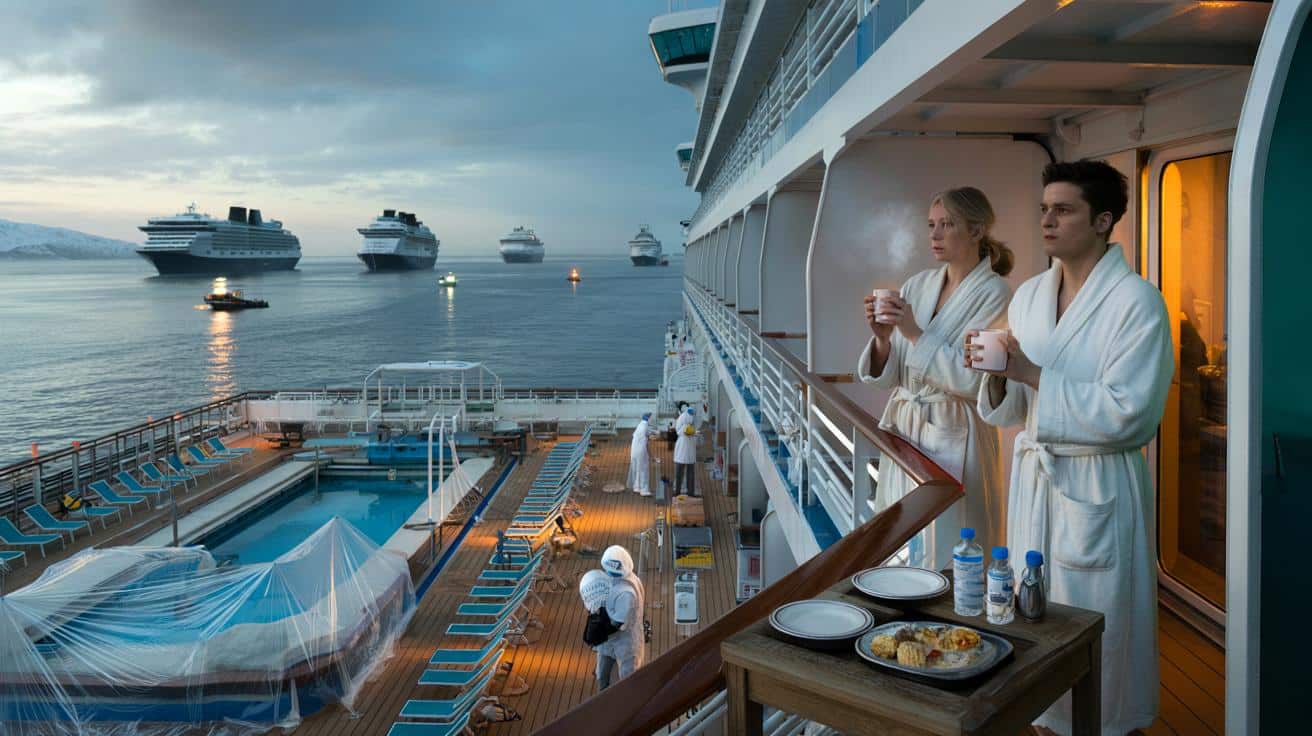
Four more cruise ships have been placed under quarantine as norovirus surges to a five-year high across winter travel routes. Ports are tightening checks, crew are moving to emergency protocols, and thousands of holidaymakers are confined to cabins while deep-clean teams work around the clock. The “winter vomiting bug” has moved from seasonal nuisance to full-blown disruption.
A crackle on the tannoy, then a calm voice asking passengers to remain in their cabins, meals to be delivered door-to-door, entertainment paused “until further notice.” On the balcony across from mine, a couple in robes stood silent, clutching mugs, watching the horizon decide whether to brighten. On a ship built for togetherness, distance suddenly ruled. The clink of cutlery from room-service trolleys became the soundtrack of the morning. Somewhere below, the kids’ club lights stayed off. The sea kept rolling. And the ship went quiet.
Quarantined at sea: the reality behind the “winter vomiting bug”
Norovirus thrives where people gather, swap serving spoons, touch rails, press lift buttons, and cross paths in tight corridors. Cruise ships are floating towns, with shared everything: air, buffets, Jacuzzis, karaoke mics, casino chips. It travels on hands faster than gossip at the lunch buffet. That’s why outbreaks can feel sudden, even if the first cases started days earlier, tucked behind a cabin door with the sign flipped to “Do Not Disturb.”
On one vessel this week, the atrium was roped off by sunrise and the pool lids were closed, blue water turning flat under plastic. Housekeeping arrived in surgical rhythm—wipe, rinse, disinfect, repeat—while stewards, gloved and stone-serious, left hydration sachets beside sealed meal trays. A crew member told me the worst part isn’t the scrubbing; it’s the quiet knock-and-step-back routine at every door, the polite retreat that says, “We care, and we can’t come in.” In a place built on service, distance feels like failure.
So why the surge now? Seasonal patterns are part of the story. Norovirus likes winter: cooler temps, more indoor time, dry air, close quarters. Cruising’s big season overlaps with peak norovirus activity on land, meaning ships can board passengers who were exposed at home, work, school, or the airport. Turnarounds between voyages are tight, and while cleaning protocols are robust, a handful of pre-symptomatic travellers can re-seed a new sailing. Quarantine trends follow that logic—when cases spike ashore, they echo at sea.
How to cut your risk on board and at home
Start with soap and hot water, and give your hands a real 20 seconds—backs, between fingers, under nails. Dry thoroughly with a clean towel or paper towel. Alcohol gel is handy for many bugs, yet norovirus laughs at it; what works here is friction and rinsing. Clean first, then disinfect: a detergent wipe to lift grime, a chlorine-based solution to kill what you can’t see. That order matters.
Skip shared serving tools when you can, or use a napkin to hold handles, then wash before eating. Eat hot food hot. Cold food cold. If someone in your cabin shows symptoms, switch to your cabin bathroom only and keep a mini “sick kit” ready—rehydration salts, disinfectant wipes, spare towels, sealed bags. Let’s be honest: nobody really does that every day. You’ll be glad you did when plans tilt.
Report symptoms early, even if it feels awkward. The medical team won’t judge; they’ve seen everything. Hydrate in sips, not gulps, and rest. Ship protocols exist to break chains of transmission, not to spoil holidays.
“Clean, then disinfect. Soap, rinse, dry. Isolate early. Small steps, big difference.”
- Wash hands with soap and water before eating and after toilet use—gels alone aren’t enough for norovirus.
- Disinfect high-touch spots: taps, door handles, flush buttons, phone screens, TV remotes.
- If ill, stay in your cabin for 48 hours after symptoms stop; norovirus can still spread post-symptoms.
- Use separate towels and a lined bin; tie and remove waste promptly when instructed.
- Call the medical centre for persistent vomiting, signs of dehydration, or care for children and older adults.
The ripple effect from cabin to coastline
Quarantine on four more ships triggers a chain you can’t see from the sundeck. Port schedules shift. Turnaround teams need longer windows. Airlines rebook returning passengers. Shore tour operators watch a week’s worth of bookings evaporate. We’ve all had that moment where a trip we dreamed about hits a wall built by something microscopic, and the disappointment sits heavier than the luggage. What happens on board doesn’t stay on board—health trends at sea mirror what’s brewing on land.
For travellers, the new reality is about flexibility. Think refundable fares, travel insurance that covers medical quarantine, and itineraries that can pivot without wrecking the whole plan. For the industry, it’s about sharpening communication, rewarding early symptom reporting, and designing spaces that are easier to deep-clean fast. The goal isn’t fear. It’s flow. Think of it as weatherproofing your winter, from cabin door to kitchen sink.
Public health teams call norovirus “self-limiting,” which is cold comfort when a holiday shrinks to a bathroom floor and a paper cup of electrolytes. Yet there’s another story here: how quickly communities—on land or at sea—can rally to slow a bug that moves like a rumour. The quarantine headlines are loud. The quiet wins are softer: a steward dropping water with a thumbs-up, a captain resetting a schedule to buy cleaning time, a family teaching a child to wash until the chorus of their favourite song ends. Those tiny rituals, multiplied, are how outbreaks end.
| Key point | Detail | Interest for the reader |
|---|---|---|
| Four more ships under quarantine | Lines activated cabin isolation and deep-clean protocols across multiple routes | Explains why itineraries change and what to expect on board |
| Norovirus at a five-year high | Winter season, dense indoor settings, and fast turnover amplify spread | Helps readers gauge risk during peak travel months |
| Practical prevention works | Soap-and-water handwashing, clean-then-disinfect, early symptom reporting | Actionable steps to protect family trips and daily life |
FAQ :
- What are the key symptoms of norovirus?Sudden vomiting, diarrhoea, stomach cramps, nausea, low-grade fever, and fatigue. Symptoms usually start 12–48 hours after exposure and often resolve within two to three days.
- Does hand gel stop norovirus?Not reliably. Use soap and water for at least 20 seconds, then dry well. Gels can be a backup when sinks aren’t available, but they’re not a substitute.
- How long am I contagious?You can shed the virus while sick and for 48 hours after symptoms stop. Some people shed longer, so keep hygiene tight for several days.
- Will a cruise quarantine mean compensation?Policies vary by line and fare type. Check your booking terms and travel insurance for medical quarantine coverage and itinerary changes.
- Is this food poisoning from the ship?Norovirus often spreads person-to-person or via surfaces. It can contaminate food, yet many outbreaks start with hand contact in shared spaces rather than a single dish.





Are cruise lines required to comp passengers for days spent in cabin isolation, or is it purely case-by-case? The piece mentions insurance and fare types, but is there any baseline policy across major lines? Also, do they extend the trip or just skip ports?