
The monthly gym direct debit is still leaving bank accounts in 2026, but the treadmills are quieter. In parks and car parks, in living rooms and break rooms, a five-move ritual is stealing the crowd. It’s cheap, fast, oddly social — and it’s helping some people shift what once felt immovable.
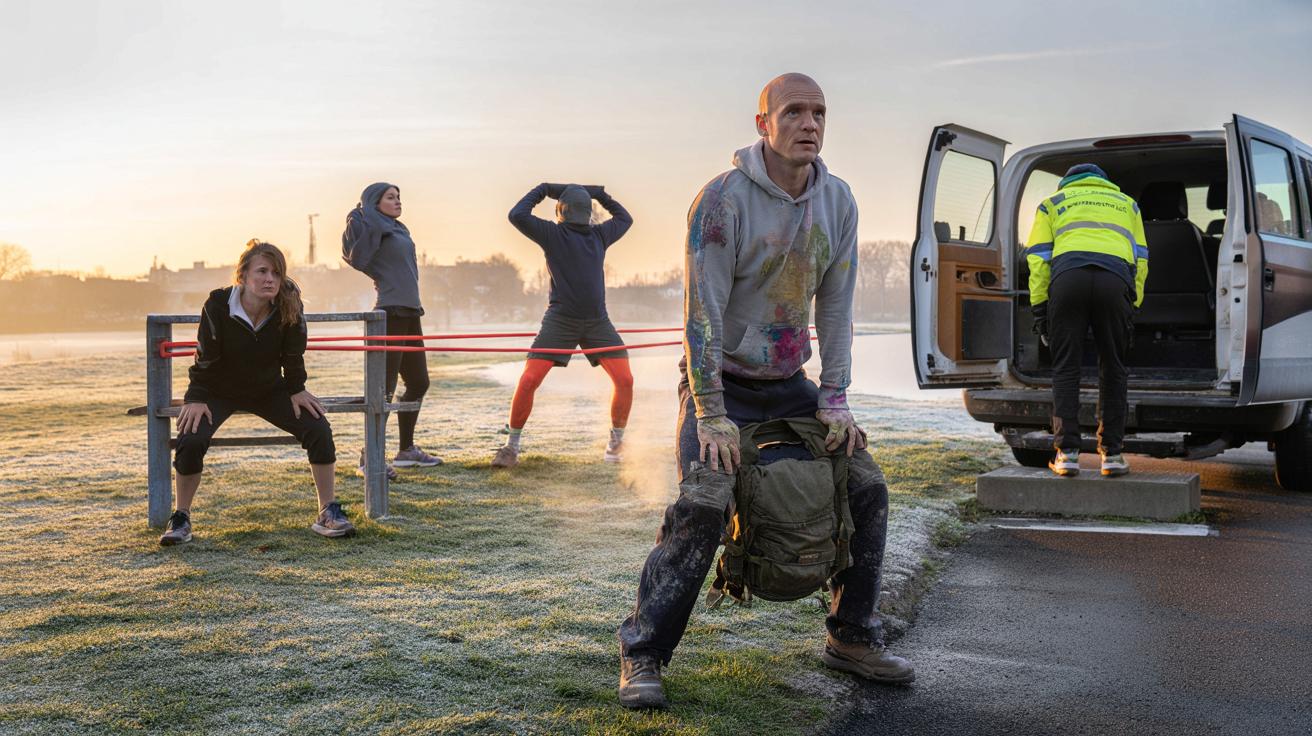
Five strangers formed a loose circle: push, pull, squat, hinge, sprint. No branded kit, no soundtrack, just the soft thud of trainers on frosty grass and a woman counting down from ten. A man in a paint-splattered hoodie wiped his forehead, grinned, and said he’d ditched his gym card months ago. The session ended in twenty minutes. He jogged to his van to start work.
He told me he’d dropped eleven stone over two patient years, moving like this and tidying up his plate. He called it “Circuit‑5”, as if it had always existed. The words stuck. The routine did, too. No membership card required.
What is Circuit‑5 — and why it’s everywhere in 2026
Circuit‑5 is simple enough to scribble on a napkin. Five compound moves. Short intervals. Repeat for twenty minutes. You work push, pull, squat, hinge, and a burst of heart-rate fire. That’s it. It slots into the odd corners of a day — before a shower, at lunchtime, at the edge of a park bench after the school run.
We’ve all had that moment when the gym fob gathers dust in a drawer. That’s where Circuit‑5 sneaks in. A nurse I met in Leeds runs it in the ambulance bay at twilight, trading the bench press for band rows looped round a railing. A dad in Swansea sprints the stairs between flats instead of a rowing machine. No friction. No commute. Just a clock and a floor.
The appeal is partly physiological, mostly human. Compound moves recruit more muscle in less time, spiking effort without demanding an hour. Habit-wise, the routine is too small to fear and too structured to ignore. You don’t debate whether to go to the gym; you glance at a timer and start the first set. Behaviour follows design when the design is this light.
How to start Circuit‑5 today
Here’s the cleanest version: set a timer for 40 seconds on, 20 seconds off. Do five moves in this order — push-ups, band or table rows, bodyweight squats, a hip-hinge with a backpack (Romanian deadlift pattern), then a sprint or fast stair climb. Rest one minute. Repeat for four rounds. Twenty-five minutes, including breath-catching and a sip of water.
Start where you are, not where you think you should be. Swap push-ups for incline push-ups on a bench if the floor feels far. Trade sprints for fast marches if your knees talk back. Let the first week be deliberately easy. Let’s be honest: nobody really does that every day. Two or three days is plenty to build a groove you won’t dread.
Think of it as a dial, not a switch. Increase reps before you add load. Nudge the work interval to 45 seconds when the 40 starts to feel tidy. The aim is rhythm, not ruin.
“Consistency beats intensity, especially when life is noisy,” says coach Mel Carter, who runs dawn Circuit‑5 meet-ups by the Mersey. “I’d rather see three gentle sessions this week than one heroic collapse.”
- Minimal kit: a long resistance band, a chair or rail, a backpack you can load with books.
- Form cues: push the floor away on push-ups, pull elbows to ribs on rows, keep the chest tall on squats, hinge at hips not back on deadlift pattern.
- Modifications: incline push-ups, seated band rows, box squats, backpack good-mornings, power walk hill instead of sprints.
- Simple log: write moves, intervals, and one note about how it felt.
- Safety mindset: warm up with two easy rounds, stop if pain bites, and keep the sprint controlled, not reckless.
Why it’s replacing memberships, not just complementing them
Cost matters, but time matters more. Circuit‑5 drains neither. It asks for a patch of ground and a watch, then gives you back a morning commute’s worth of minutes. People stack it into life without scheduling acrobatics. That’s the unlock.
There’s also ego-free community. A WhatsApp ping at 6:45 — “Car park, two rounds, who’s in?” — can do what a glossy billboard cannot. You all turn up in whatever you slept in, you move, you laugh at the wind, you head to work feeling oddly proud. *This isn’t a miracle, it’s a repeatable pattern.*
Progress sneaks up. First a deeper squat, then a firmer hinge, then the quiet surprise of breathing easier up the stairs. You don’t need to chase soreness to know it’s working. You need to show up often enough to let your nervous system learn the shapes. Momentum beats motivation most days, and routine beats both.
Where this could go next
The old gym isn’t dying, it’s evolving. More studios are carving out “open floor” slots where members run personal Circuit‑5s without queuing for machines. Office blocks are painting numbered steps on stairwells to nudge lunchtime sprints. Councils are sketching five-move circuits into pocket parks, with rails at different heights and distance markers underfoot.
At the same time, the culture is shifting. You don’t need to rebrand your life to get fit; you need five reliable moves, a friendly countdown, and someone who’ll nudge you on a wet Tuesday. That’s oddly liberating. It turns fitness from a destination with a turnstile into a thing you do while waiting for the kettle to boil.
If Circuit‑5 continues its quiet spread, it won’t be because it’s fashionable. It will be because it respects the mess of real schedules, shrinking the barrier so low you can step over it without thinking. Maybe that’s the real transformation here: not just bodies, but the story we tell ourselves about what counts as “enough”.
| Key point | Detail | Interest for the reader |
|---|---|---|
| Simplicity wins | Five moves cover push, pull, squat, hinge, and a cardio burst | Clear, memorable structure you can do anywhere |
| Small doses, big return | 20–25 minutes with work/rest intervals and four to five rounds | Fits into mornings, lunch breaks, and travel days |
| Flexible by design | Easy swaps for every fitness level and every joint | Reduces fear of failure and keeps you turning up |
FAQ :
- What are the five moves in Circuit‑5?Push-up, row, squat, hip-hinge (like a Romanian deadlift), and a sprint or fast stair/hill effort.
- Can beginners do this safely?Yes. Use incline push-ups, seated or band rows, box squats, light backpack hinges, and brisk walks instead of sprints while you learn the shapes.
- How often should I run Circuit‑5?Two to four times a week works for most. Keep at least one full rest day, and treat the final round as “leave a little in the tank”.
- Will I build muscle with bodyweight and bands?You can build and keep solid muscle by progressing reps, tempo, and load in that backpack or band. Eat enough protein and sleep like it matters.
- What if I get bored?Rotate variations: incline or diamond push-ups, single-leg squats to a box, band pull‑aparts, hill sprints, or shuttle runs. Same pattern, fresh flavour.








Tried Circuit‑5 this mornng in my living room — 40s on/20s off for 4 rounds — and I actually finished in under 25 minutes before work. The “dial, not a switch” idea is gold. Swapped push‑ups for an incline and felt zero dread. Cheers for the clear cues and safety reminders!